Triangle Grids

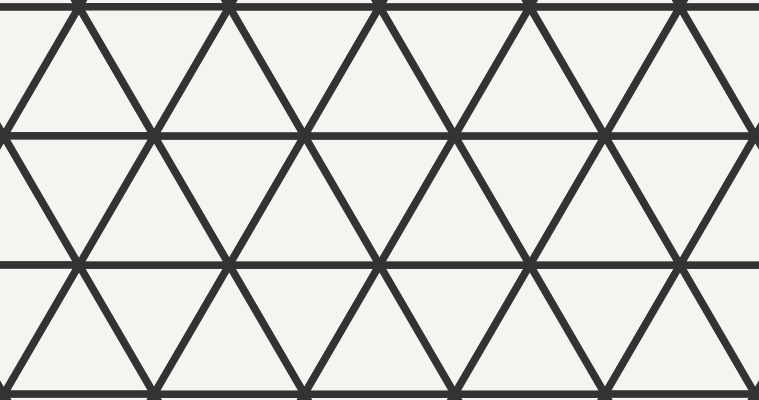
Ah, the triangle grid. Square grids are virtually ubiquitous, laying out out everything from the pixels in an image to houses in a city block. The hex grid has a decent showing too, particularly in board games. But triangle grids – regular tilings of the 2d plane with equilateral triangles – just don’t seem popular. I’ve seen claims they are useless, or that the maths is hard. But I’m here to prove both of these are wrong: the maths is actually easier than working with hexes, and triangles have all sorts of neat advantages.

I’ve worked out all the maths in my reference code on github, but it’s worth explaining why and how to use these grids.

Continue reading →

Lock and Key Dungeons

Lock and key dungeons are, well, video game levels with locks preventing progress, and collectable keys that let you proceed.

The concept is a lot broader than it sounds. Locks/keys aren’t necessary physical objects, but anything that works in a similar way, which can often be quite abstract.

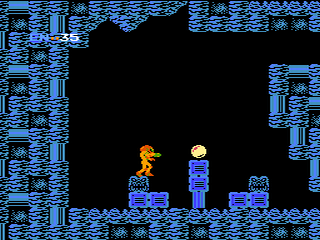
In Metroid 1, you cannot exit through the hole at the right (the lock) until collecting the morphball upgrade (the key)

Once you are familiar with the pattern, you begin spotting it everywhere. It’s most prominent in puzzle games and metroidvanias, but it’s applicable to any game which has an authored progression path.

In this article, we’ll look at lock and key dungeons, then how to analyse and design them.

Continue reading →

Dungeon Generation in Binding of Isaac

The Binding of Isaac, and its remake, Binding Of Isaac: Rebirth are one of my favourite games of all time. It’s a roguelite twin stick shooter, much like Enter the Gungeon.

The dungeons it generates are particularly iconic. I’ve seen countless tutorials online offering how to do Isaac-like generation, but I was interested in how the original did it. To my suprise, most tutorials get it wrong. In this article I go over how the generation works, including a Javascript demo.

Continue reading →

Wave Function Collapse Explained

A simple guide to constraint solving

Since developing DeBroglie and Tessera, I’ve had a lot of requests to explain what it is, how it works. The generation can often seem quite magical, but actually the rules underlying it are quite simple.

So, what is the Wave Function Collapse algorithm (WFC)? Well, it’s an algorithm developed by Maxim Gumin based on work by Paul Merrell for generating tile based images based off simple configuration or sample images. If you’ve come here hoping to learn about quantum physics, you are going to be disappointed.

WFC is capable of a lot of stuff – just browse Maxim’s examples, or check out #wavefunctioncollapse on twitter, or see my youtube video.

WFC is explained briefly in Maxim’s README, but I felt it needed a fuller explanation from first principals. It is a slight twist on a much more broad concept – constraint programming. So much of this article is going to explain constraint programming, and we’ll get back to WFC at the end.

Continue reading →

Marching Cubes Tutorial

In Minecraft, you can dig in any direction – removing a block at a time with well defined edges. But other games manage to destruct terrain smoothly, without all the blockiness of Minecraft.

The following tutorial in Marching Cubes, a technique for achieving destructible terrain, and more generally, creating a smooth boundary mesh to something solid. In this series, we’ll cover 2d in this first article, follwed by 3d in the next , and Dual Contouring in the third. This last is a more advanced technique for achieving the same effect.

Continue reading →

Tileset Roundup

Following my development of Resynth Tileset, I’ve been doing some thinking on the nature of tilesets, and the possible ways to auto tile them – that is, to paint tiles as is with a brush and letting the computer do the tile selection. Let’s review a few possible ways of doing so.

Just to be clear, I’m only interested at the moment in square, non-rotatable tiles. Rotation is another discussion, but excludes the more interesting tilesets. Adding alternative tiles is also not considered, though it is pretty easy to add in.

Continue reading →